Leaving Antigua, W. I.

Tuesday, November 29, 2011

Resting in Antigua

Deshaises, Guadeloupe, F.W.I.
We're in Antigua, resting from four days of great sailing on the way up from St. Lucia.  There was good wind for the trip, with one or two small storms each day to keep us on our toes and give us a little practice at dropping our big Yankee jib in a hurry.  We blew out a panel in it a couple of years ago in a squall, and we couldn't remember to get it fixed.  Most of the time, we fly our smaller Yankee in conjunction with our staysail.  With one reef in the mainsail, that's the right combination for the normal 15 to 20 knot winds that we have in the islands.  While we were in St. Lucia, we saw a forecast for lighter winds and remembered to take the sail in to the loft  for repairs.  It was nice to have it back in the 12 knot winds we had for most of the trip.

The last day, from Deshaises, Guadeloupe to Jolly Harbour, Antigua, we had a forecast for 20 knots on the beam, so we changed down to the smaller Yankee, surprised again at how much easier it is to handle.  The wind came as forecast, and the seas were sloppy, but we had a 7 hour trip over the 52 nautical miles.  We averaged over 7 knots, pushing the boat at hull speed the whole time.  Glad we weren't trying to fly  the big sail.

There's a trough affecting our weather at the moment, with winds out of the southeast.  That would certainly push us to St. Martin, but we would be dead downwind the whole time -- not our favorite point of sail, especially in sloppy seas.  Besides, our friends Kim and Sandi on Kewaydin are stranded here with engine trouble, so we're enjoying their company while they wait for parts.  We'll probably leave for St. Martin sometime next week.

Tuesday, November 22, 2011

Happy Thanksgiving!

You know you've been in one place too long when the excursion boats add you to their itinerary.  I looked out the port the other day and saw the folks along the rail of this schooner with their cameras, making pictures of the little boat.  That would be Play Actor, I think.  We have been here in St. Lucia for a little over two weeks, and we are still enjoying it.  We always do -- Rodney Bay is a favorite spot of ours.  It's a good anchorage with attractive scenery and clean water in which to swim.  There's a lot of water-toy activity with people from the resorts capsizing their Hobie cats and paddling their kayaks, so we can drink our coffee in the shady cockpit and watch the tourists change color from pasty white to hot pink, right before our eyes.  At just 12 degrees above the equator, the attenuation of UV by the atmosphere is much less than at higher latitudes, because the rays have a much shorter trip through the air.  It doesn't seem any brighter or hotter, -- in fact, it's in the low 80's here -- but exposed skin will burn in minutes.  We're planning on leaving later this week.

We've been watching the weather, waiting for a few days of good breeze to take us to Antigua, and then on to St. Martin.  The low pressure system that's east of Bermuda has been blocking the trade winds for the last few days, otherwise we would have left already.  We went grocery shopping several days ago to provision for the trip,  and now we've eaten our stock.  It's time to go shopping again.  We tried it yesterday, but discovered that it was really time to rebuild the carburetor on the outboard instead.  That done, we're off to the grocery store this morning, with an eye toward a Thursday morning departure.

We'll probably spend Thanksgiving Day at sea.  Think of us when you're eating your turkey -- we'll probably be eating peanut butter and jelly sandwiches, unless the fish happen to be running.  If we get lucky with a tuna or mahi-mahi, we'll steam some rice and have sashimi in the cockpit.  Happy Thanksgiving.

Sunday, November 13, 2011

Changes in Latitude


Port Egmont, Grenada

It's that time of year again.  Fall is in the air, even in the tropics.  It's cool enough at night so that we're often sleeping under a sheet.  Hurricane season has fizzled out, and we're actually sailing again.  We've moved from 12 degrees north all the way up to 14 degrees -- about 120 miles.


The beach at Pigeon Island, St. Lucia

We've been in St. Lucia for about a week now, enjoying the change of scenery.  We're anchored right off the beach, near a couple of big resorts.  We enjoy sitting in the cockpit in the shade, watching the folks from Sandals sail by on the Hobie cats, or paddle by in their Kayaks.  We manage to ignore the occasional jet ski -- they're like mosquitoes, only bigger.  We already miss the peace and quiet of Grenada, but we're excited at the prospect of sailing again.  We'll be here a few more days, and then we'll move on.

We have about five days of sailing time between here and St. Martin, where we'll settle for a couple of months and stock up on the things that we can't get in the islands farther south.  We'll do a few minor repairs -- no new engine this winter -- where it's easy to get parts.  St. Martin is also one of the few places we've found in this part of the world where we can get fresh pecans, that staple in a southern boy's diet.  We always leave there with a few pounds stashed away to mix in our breakfast cereal.

Tuesday, October 25, 2011

Take a Winter Vacation for Free. Go to the Dentist.

We're starting to think about heading north for the winter.  How's that sound to you folks who don't live in the tropics?  Hurricane season is almost behind us.  If it will just stop raining long enough, we'll stock the larder, fill up with diesel, shake out the sails, and head north, up to where it's cooler, like St. Martin, maybe?  That's far enough.  We don't want to find cold weather.

Part of our pre-departure routine is a visit to the dentist, which we did yesterday, in the pouring rain.  We've found dental care to be a real bargain down here.  After trying it out in several places, we've found a lady we like, here in Grenada.  She studied in England, and her partner in the practice studied in the U. S.  They both grew up in Grenada, and when they finished school, they decided to come back and open a practice with all of the latest equipment.  They've been at it for a couple of years, now, and they're thriving.

Yesterday, we both had a check-up and cleaning, with x-rays.  Bud had a minor filling done, as well.  The total charge, for both of us combined?  About $90, U. S.  Who needs dental insurance?  Back when we had it, our share of the cost for similar services was more than that, and that was over 10 years ago.

We've had similar experiences with medical care.   Want a vacation in a tropical paradise this winter?  Come down for your dental work.  You'll save enough over what it costs in the States to pay for the trip.

Monday, October 17, 2011

iPhones, iPods, and Yacht Provisioning

Grocery shopping takes a lot more time in this cruising life than it did when we lived ashore.  When non-cruisers ask us what we do all day to stay busy, provisioning is high on the list, and only partly for the reasons mentioned in our last post.  It is harder for us to get to the grocery store than it was when we lived on dirt, but there are other differences.
Dungda de Islan', where we live, we usually have to visit several stores, and perhaps an open air market or two, to find what we need for the week (or month, depending on our plans.)  Store stocks aren't replenished as often, and what's available is largely dependent on what was on the last ship.  It's quite different from getting in the car, going to the nearest supermarket, and buying everything on your list.  Oh, sure, you might want to shop price, but that's an option, not a necessity.  Here, one grocery store may have cornered the market on peanut butter.  Invariably, a competitor has all of the jelly in town.  Or maybe this week, everybody has peanut butter, but all of the jelly went to the next island to the north.  We've developed a maxim that we call "the rule of the islands."  It's simple:  If you see it and you think you might want it, buy it, right now.  If you go back later, it will be "finished," as they say down here, or sold out as we used to say.  And there may well never be a next shipment.
Besides availability, there's the problem of where to put everything when we get home to the boat. We have a lot of storage space, but it's spread over the entire vessel; a little locker here, space under the floorboards there, the cabinet concealed behind the settee cushions. You get the idea. When we were cruising out of the way places, we stored several months worth of food aboard. The last time we did that was several years ago, and we still find some of that stuff, every so often, in a forgotten corner. To avoid turning our provisions into science experiments, we've tried using lists, card files, spread sheets, you name it. We couldn't find a workable solution until recently.

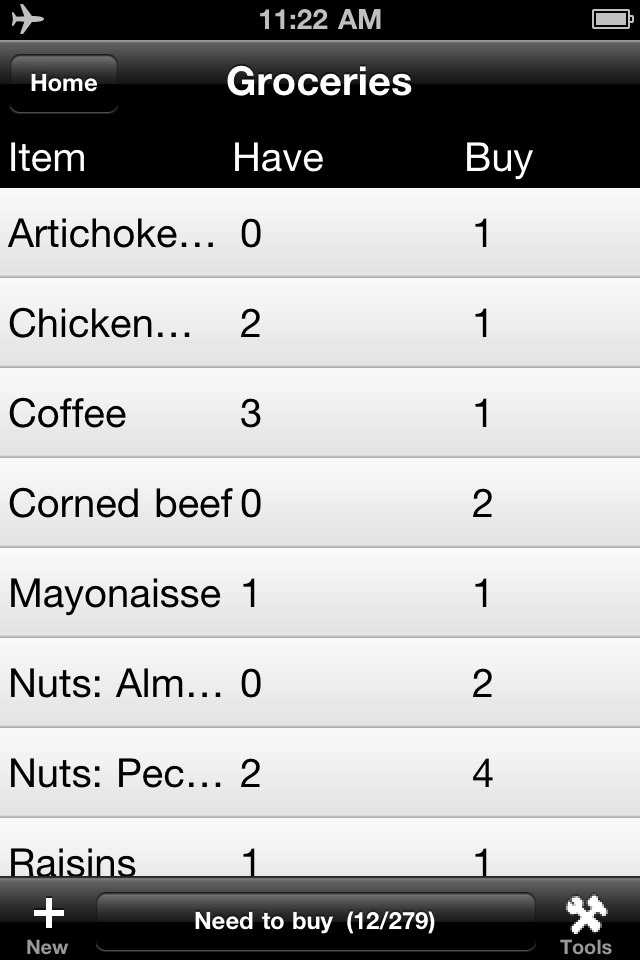
We're now using a database management app on our iPod Touches.It’s called HanDBase, and it costs just a few dollars.It runs on all the magic iOS devices.It's straight forward to use, and we've developed databases for groceries, other consumables, and spare parts, all of which present the same acquisition and storage problems.
The screen shots are mostly self explanatory. The first one is the "default view," which is just a list of the items in our grocery database, with quantities on hand, quantity in each of several storage locations, target stock level, and a "Buy" quantity. The next screen is the "Need to Buy" view, which lists the only the items with a buy quantity of 1 or greater. That is the essence of our shopping list. We have 279 items in our grocery database, and 111 discrete storage locations; hence the need for an organized approach.

The last two shots show the details for an item record. This one happens to be coffee.

Because our iPod Touches go everywhere with us, the database is easily kept up to date. In fact, we keep recipes in another app called GoodReader, so when we're cooking, it's a matter of seconds to update the database as we use things. We always have the database available when we are shopping, so we know exactly what we need. There's space in each record for notes and favored brands, as well as typical prices, so if we find something that we aren't expecting, we can make an on the spot decision to buy or wait, knowing whether it would likely be cheaper in a different country. And, now that we've looked in all of those 111 storage locations, we aren't finding moldy surprises.

Just one more thing that we didn't think about when we were dirt dwellers

Monday, October 10, 2011

Grocery Shopping in Paradise

We've been trapped on our boat in a secluded anchorage for the last couple of weeks.  We've had tropical downpours virtually everyday, so going to town for groceries wasn't appealing.  We like the anchorage, because most of the time, there aren't any other boats around -- a rare thing in Grenada during hurricane season.  The downside is that shore access is limited.  There are a few private docks, but we think that being a good neighbor to the land-based folks means not intruding on their privacy, so we don't ask to use their docks.  We use our rowing dinghy to go ashore, instead of our rigid inflatable, because the rowing dinghy is more rugged, and we tie it off to the mangroves on a bit of bridge right of way.  Then we take off our shoes and wade ashore through the swamp, climbing up the bridge abutment to the road.  Once there, we have a short hike to a bus stop, where we can catch a bus into St. Georges, the capital city of Grenada.


The buses are actually small passenger vans, not as big as the SUV's that people in the States drive solo, and they are configured to seat 12 to 15 people.  When the bus stops, the conductor (Yes, there's a conductor on the bus!) slides the side door open and hops out to help you clamber aboard and find a seat.  Everyone scrunches up to make room, after exchanging polite, "Good mornings," or "Good afternoons," and you wedge yourself into any available space.  It's a chance to make personal contact, literally, with local inhabitants.  Personal space is an unknown concept -- everybody shares happily.  It's actually a pleasant experience that will restore your faith in your fellow man.  Once everybody is greeted and seated, the conductor climbs back aboard and the bus departs for the next stop -- often a few hundred yards away.  When the bus approaches your stop, you either call out, "Next stop, please," or, if the din of the radio is too loud, you rap on the ceiling.  The bus stops, the conductor hops out, and everybody willingly makes whatever accommodation in required to allow egress for the departing passengers.  When you get off, you pay the conductor, typically about the equivalent of a dollar.  It may not sound like it, but it's a surprisingly efficient way to get around.


Once we find what we need in the way of groceries at the various local markets in town, we head for the main bus terminal where we repeat the process.  Once back aboard Play Actor, we strip the packaging -- who wants to store all that cardboard -- and Leslie puts things away while I update our grocery database.  The database is important, given how involved shopping can be.  We have a lot of storage space aboard, but not all of it is readily visible, so it's important to know where the extra peanut butter was stashed.  It's equally important to know what we have and what we need, every time we go shopping.  More on the database next time…

Sunday, September 18, 2011

Tuna Trouble: The Smallest One We Ever Caught

Rainy days are hard on our energy conservation program, especially the kind of windless, rainy days we've had lately.  The solar panels and the wind generator can't keep up with our electrical consumption in this kind of weather, so yesterday, we had to run the diesel to charge our house battery bank.  What does that have to do with catching fish?  Well, read on. 

The last few times we've run the engine, we noticed the exhaust sounded a little throatier than usual.  For any non-boaters, the exhaust on most sailboats is cooled by injecting the seawater, which has already passed through the engine cooling system into the exhaust hose before it reaches the muffler.  Normal exhaust noise is a soft spluttering, splashing sound, as opposed to the throaty rumble we were hearing.  Our thoughts were that the cooling water flow was restricted, somehow, but we had cleaned the intake filter and checked for obvious obstructions.  Everything was as it should be.  Maybe the engine's voice is changing, now that it's broken in? 

At the end of the charging cycle yesterday, the exhaust discharge was clearly much drier than it had been at the start.  Something had changed, and the problem was getting progressively more serious.  I cleaned the filter again, washing the strainer basket in the galley sink.  It had a little crud in it, but wasn't dirty enough, to my thinking, to have caused our problem.  I replaced it in the strainer, and as I was about to start the engine to test everything, Leslie exclaimed, "There's a fish eye in the sink!" 

"What?  Are you sure?"  I asked. 

"You know how I like fish eyes.  I know a fish eye when I see one!"  She quipped, referring to all of the times she had been a guest at one of my business dinners in the days when I traveled in Asia.  She was often the only woman around, and so was treated as the guest of honor, which meant she was served with the choicest morsels.  She did acquire some odd tastes, and she does know her fish eyes better than most. 

"Wonder how that got there?"  I muttered, as I started the engine.  There was no change in the exhaust discharge, so I shut it down.  I took the top off the strainer and opened the inlet valve, cautiously, expecting a flood of seawater, as this is below the waterline.  Nothing happened, indicating an obstruction between the intake and the strainer.  I began methodically removing the hose connections between the seawater intake and the strainer, finding no obstructions until I reached the inlet valve at the sea strainer.  When I took the hose off the valve, I found about four inches of the back end of a little yellow fin tuna, hanging down out of the valve body.  Should have made a picture, but I was in too big a hurry.  I grasped the tail and gently tugged the fish out.  It was about six inches long, and the head would not quite fit into the valve, which is slightly narrower than the hose.  The suction had mangled the head end of the fish where it stuck in the valve entrance, and, yes, Leslie, it was missing an eye, but was otherwise in good shape.  Given that we weren't hungry, we tossed the fish over the side and put everything back together. 

The engine sounds normal, but we do wonder how long the little rascal was in there.  There is a good-sized chamber just where the hose attaches to the through-hull intake seacock.  The fish could have been living there for a while, and only occasionally causing an intermittent problem in our cooling water flow, until it finally got sucked into a narrower part of the system,  Hope it wasn't a claustrophobic tuna.